Real-Time VHF Meteor Scatter Telemetry & VR Visualization
Project Name: Real-Time VHF Radio Meteor Scatter Telemetry and VR Visualization
Technologies: Unreal Engine 5, Python, VHF Radio Hardware (Dipole Antenna, RTL-SDR, Telescopes and Astrocameras)
Role: Solo project (2025 – Present)
Licenses: Federal Communications Commission (FCC) issued Amateur Radio License (Call Sign: K2EXO)
Paper Publications: In progress
Overview:
When meteors enter Earth's upper atmosphere (80-120 km altitude), they create brief trails of ionized plasma capable of reflecting Very High Frequency (VHF) radio waves over the horizon. This project is an end-to-end hardware-to-VR telemetry pipeline that captures live VHF radio reflections using Software Defined Radio (SDR) hardware, processes raw I/Q signal streams in Python, and renders the detected atmospheric meteor events dynamically inside Unreal Engine as a 3D VR simulation.
Key Engineering Highlights:
• VHF radio components - including but not limited to - a Dipole Antenna and RTL-SDR are used to listen to specific radio frequencies. This raw frequency data is fed to a computer running Python and Unreal Engine.
• Python DSP code performs the raw I/Q Stream Processing. It ingests continuous raw radio-frequency I/Q samples at 240k S/s across various frequencies, for example 52.460 MHz, 54.310 MHz, and 90.1 MHz.
• DSP logic performs various functions such as Noise Floor Tracking, Dynamic Calibration based on current radio frequency pollution around the receiver, etc. This is done to filter out static pops, electrical interference, and slow-moving aircraft Doppler reflections.
• So far, I have collected a structured telemetry dataset spanning 18 months. It includes continuously logged timestamps, noise baselines, peak signal power, and delta dB values. So far I was able to validate 150+ meteor events that happened during various peak meteor showers windows such as Perseids and Geminids meteor showers.
• Unreal Engine 5 C++ Visualization: Architected a game in Unreal Engine that parses incoming telemetry logs and dynamically spawn, positions, and scale 3D meteor representations for immersive spatial inspection in VR.
Future Roadmap - 3 Node city-wide Interferometry Array:
• Currently expanding the hardware testbed using three synchronized receivers and antennas deployed across multiple geographic baselines to implement Time-Difference-of-Arrival (TDOA) and interferometry calculations, it could enable 3D triangulation of meteor trail direction and range.
• Also working on building a pipeline for visual confirmation using an astrophotography camera with a fish-eye lens. Given the fact that meteors are random, it is difficult to test the system in real time. Having wide angle camera for visual confirmation could help in validating the radio signals.
Screenshots, photos and Videos:
Video: Detection of a meteor ping visible in a spectrum analyzer software (Airspy). The noise you hear and the blue waterfall color are the background radio waves being received in a certain frequency range. The white spots appearing in the middle are pings left by meteors.
Video: Screen recording from a VR scene in Unreal Engine showing meteor spawning in real-time after getting parsed from input signal
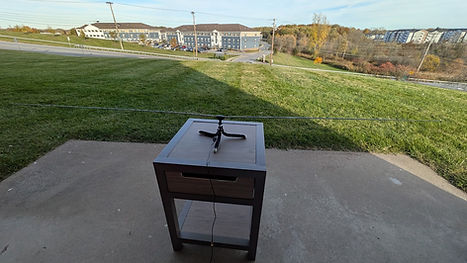


Images: Some of the hardware that I use for detection or validation (Dipole Antenna, ZWO ASI 585MC camera, Celestron 8SE telescope)